7 best places to walk near you
The best choice depends on whether you want calm, scenery, discovery, or the shortest possible planning time. Start with one of these settings.
-
01
A nearby park
Best for greenery, clearer paths, benches, and an easy option to shorten the walk.
-
02
A waterfront path
Choose a river, canal, lake, or seafront when you want scenery and a simple line to follow.
-
03
A quiet neighborhood loop
Start from home, work, a hotel, or a station when you want to spend your time walking rather than travelling to a trailhead.
-
04
An old city center
Choose historic streets when you want architecture, local life, landmarks, and public transport nearby.
-
05
A wooded park or forest edge
A useful middle ground when you want shade and quieter surroundings without committing to remote terrain.
-
06
A coastal path or viewpoint
Good for open views, but only after checking wind, weather, surface, access, and daylight.
-
07
A circular route from here
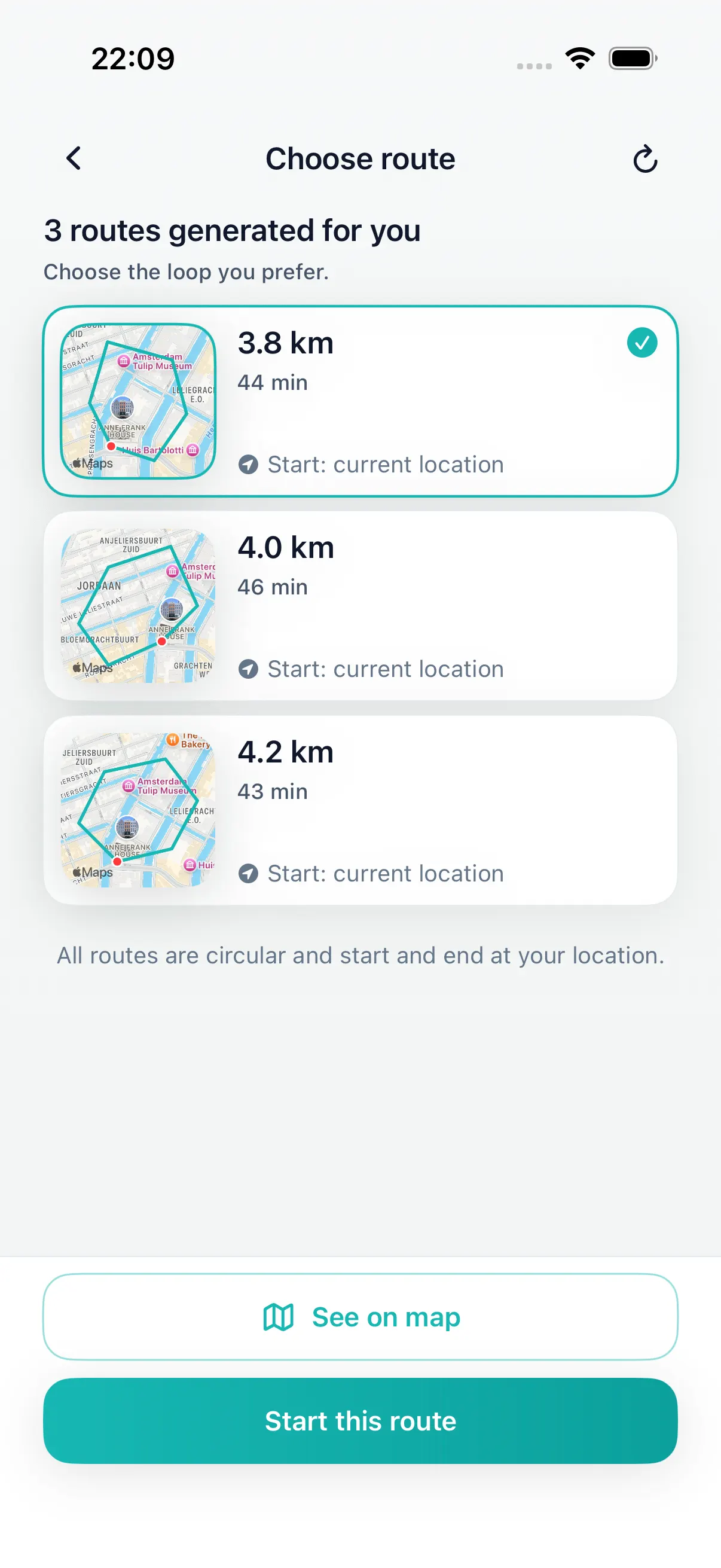
The fastest answer when the place matters less than getting outside: choose time or distance and return near your start.
Do you need a named place or a route from here?
These are different search jobs. Choose the path that matches what you need today.
| Use case | Find a named place | Create a local loop |
|---|---|---|
| Start with | A park, trail, waterfront, or city name | Your current location plus time or distance |
| Use | Local or official park and trail information | DailyWander on iPhone |
| Check | Access, closures, terrain, facilities, and return transport | Each generated map plus current local conditions |
| Result | A destination or established trail | A circular everyday walk that returns near the start |
How to choose a good walk near you
A short check prevents a promising place or generated route from being wrong for today.
-
01
Set the real time or distance
Include the trip to the start and the journey back. For a short break, a loop from your current location is often the practical choice.
-
02
Match the setting to today
Use weather, daylight, surface, traffic, and energy level to choose streets, parkland, water, woods, coast, or hills.
-
03
Check current local information
For named parks, trails, and protected areas, confirm access, closures, permits, difficulty, and official notices.
-
04
Keep a second option
If the first place or generated route looks too exposed, busy, steep, or long, choose another one before starting.
A place can look good online and still be wrong today
- Check official access and closure information for named trails, parks, and protected areas.
- Match the surface and elevation to your footwear, mobility, and available daylight.
- Look for a clear return plan: loop, out-and-back, or public transport.
- Use a shorter route in heat, storms, ice, high wind, or poor visibility.
- Do not treat a mountain walk like a short neighborhood loop.
Looking for a particular city or walking area?
Use our researched walking guides for Amsterdam, Paris, Dutch Limburg, Madeira, Iceland, and the Alps when the destination itself is the reason for your walk.
Use DailyWander when you want an everyday circular route from your current location rather than another list of places to travel to.
FAQ
Best places to walk questions
What are the best places to walk?
Good options include nearby parks, paths beside water, quiet streets, old city centers, wooded areas, coastal paths, and marked local trails. Pick one that suits your time, the weather, and the surface you want to walk on.
How do I find good places to walk near me?
Decide whether you need a named destination or simply a walk from where you are. Check local or official information for parks and trails. For an everyday loop from your current location, DailyWander can generate several options on iPhone.
Does DailyWander list named parks and trails near me?
No. DailyWander is not a directory of named parks or trails. It creates circular everyday walking routes from your current location. Use local or official sources when you need a specific destination, access details, or trail conditions.
Is a park or a city better for walking?
A park is a good choice for greenery and quieter paths. A city walk is better when you want architecture, local streets, landmarks, or an easy link to public transport.
Do I need a named trail for a good walk?
No. A loop through nearby streets can be a perfectly good daily walk. Use official trail information when access, waymarking, terrain, or a particular destination matters.
How do I choose a safe walking place?
Check access, closures, weather, daylight, surface, and elevation before you leave. Shorten or postpone the walk if the conditions do not suit your experience or equipment.
DailyWander
Turn where you are into today's walk.
Download DailyWander on iPhone, choose time or distance, and compare circular routes that return near your start.
