Japanese walking: the 30-minute interval method
Quick answer: Japanese walking is interval walking training. Walk fast for 3 minutes, then easy for 3 minutes, and repeat five times for a 30-minute session. Do it at least four days a week. It was developed by researchers at Shinshu University in Japan, who found that it improved leg strength, fitness and blood pressure more than walking at a steady moderate pace.
You need no equipment, only a timer and a route about 30 minutes long. A loop that starts and ends at your door is ideal, because you are never far from home when you finish.
How to do Japanese walking
- Warm up with a few minutes of easy walking.
- Walk fast for 3 minutes. Fast means you can still talk in short phrases but not sing, roughly 6–7 out of 10 effort.
- Walk easy for 3 minutes. A relaxed pace where you can hold a full conversation, roughly 3–4 out of 10.
- Repeat for five rounds: 15 minutes fast and 15 minutes easy, 30 minutes in total.
- Aim for at least four sessions a week. That adds up to an hour of fast walking a week.
Keep your posture tall, take quicker steps rather than longer ones, and let your arms swing. If 3 fast minutes is too much at first, start with 1–2 fast minutes and build up.
What the research found
Interval walking training was studied by Hiroshi Nose, Shizue Masuki and colleagues at Shinshu University in Matsumoto. In a 2007 study of 246 adults with an average age of 63, one group walked at a steady moderate pace and another alternated 3 minutes at about 70% and 3 minutes at about 40% of their peak aerobic capacity.
After five months, the interval group improved knee extension strength by 13% and knee flexion strength by 17%, gained more aerobic fitness and had a larger drop in resting systolic blood pressure than the moderate-pace group. Nemoto et al., Mayo Clinic Proceedings, 2007
The studies focused on fitness, strength and blood pressure in middle-aged and older adults. Weight loss was not the main outcome, so treat it as a bonus of more active minutes rather than a promise.
Japanese walking vs 6-6-6, 12-3-30 and 10,000 steps
| Routine | What you do | Time per session | Best for |
|---|---|---|---|
| Japanese walking | 5 × (3 min fast + 3 min easy) | 30 min | More effort in a short walk; outdoors, no equipment |
| 6-6-6 walking | 6 min warm-up, 60 min brisk walk, 6 min cool-down, often at 6 am or 6 pm | 72 min | A fixed daily slot and a long, steady walk |
| 12-3-30 | Treadmill at 12% incline and 3 mph for 30 min | 30 min | Indoor uphill walking |
| 10,000 steps | Reach a daily step total in any way | All day (about 80–100 min of walking) | Overall daily movement |
None of these is magic. They package walking into a routine that is easy to remember. Pick the one you will keep doing, and combine them if you like: a Japanese walking session counts toward your daily steps.
The 6-6-6 walking rule
The 6-6-6 rule is a social media routine: a 6-minute easy warm-up, a 60-minute brisk walk and a 6-minute cool-down, ideally at 6 am or 6 pm. There is no research on the routine itself, and nothing special about those hours. Its value is structure: one long brisk walk at the same time each day.
Four sessions a week already give you more than the 150 minutes of moderate activity that US guidelines recommend. CDC physical activity guidelines If 60 minutes is too long, start with 20–30 minutes and build up, or swap the middle hour for Japanese-walking intervals.
The 12-3-30 workout
12-3-30 is a treadmill routine: set the incline to 12%, the speed to 3 mph (about 4.8 km/h), and walk for 30 minutes. The incline makes it much harder than flat walking, so start lower if you are new to it, and avoid holding the handrails. Outdoors, a hilly 30-minute loop gives a similar effect.
Where to do Japanese walking
Intervals are easiest on a route with few stops: quiet streets, a park loop or a riverside path, so a red light doesn't cut a fast stretch short.
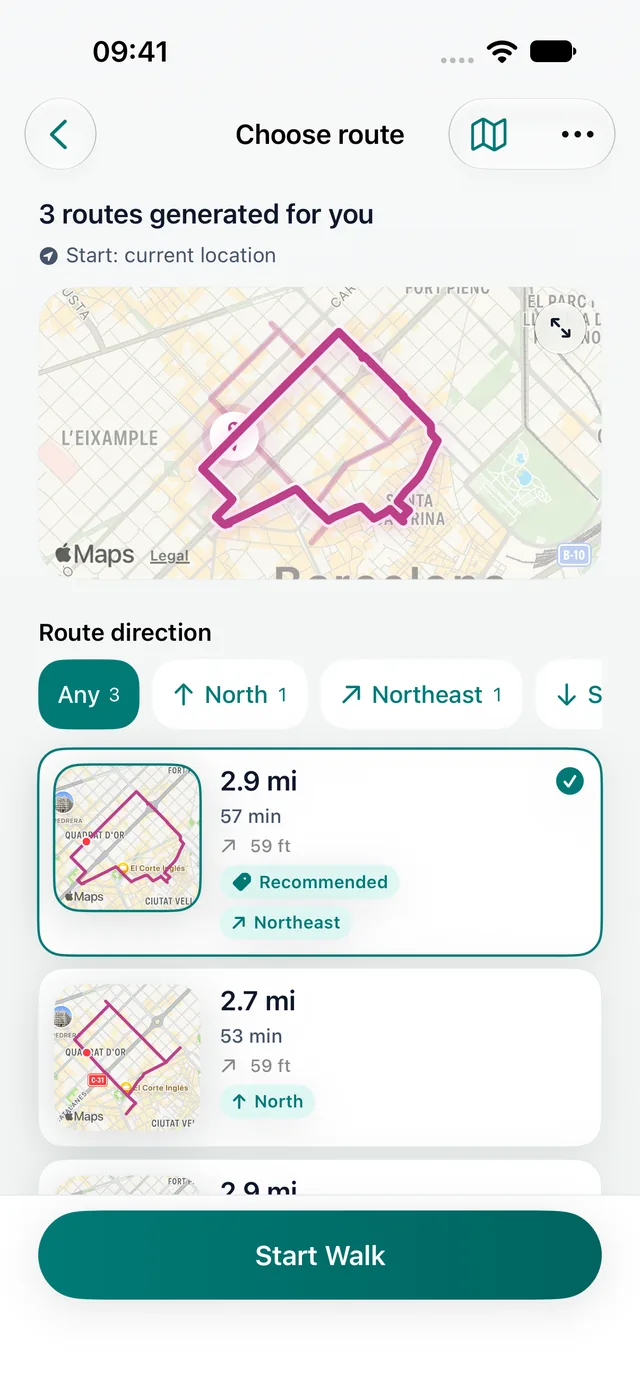
A 30-minute loop from your door works well: you warm up on the first streets, do your five rounds, and finish at home. Daily Wander, our iPhone app, can generate one: choose 30 minutes or a distance, check the loop on the map and start walking. See the 30-minute walk route planner, or plan by time with the walking route planner by time.
How far will you get? At an easy 3 mph and a fast 4 mph, 30 minutes of Japanese walking covers roughly 1.75 miles (2.8 km). Check your own pace with the walking time and distance calculator.
Safety
Japanese walking is moderate exercise, but the fast intervals raise your heart rate. If you have a heart condition, high blood pressure, joint problems or are new to exercise, check with your doctor first. Stop if you feel chest pain, dizziness or unusual breathlessness.
FAQ
What is Japanese walking?
Japanese walking, or interval walking training, alternates 3 minutes of fast walking with 3 minutes of easy walking for 30 minutes, at least four days a week. It was developed at Shinshu University in Japan.
Does Japanese walking help you lose weight?
It adds more effort to the same walking time, which helps when combined with eating habits that create a calorie deficit. The original studies measured fitness, leg strength and blood pressure rather than weight loss.
How fast is "fast" in Japanese walking?
Fast enough that you can speak in short phrases but not sing, roughly 6–7 out of 10 effort. In the research it was about 70% of each person's peak aerobic capacity.
What is the 6-6-6 walking rule?
A routine of a 6-minute warm-up, a 60-minute brisk walk and a 6-minute cool-down, often done at 6 am or 6 pm. The timing is flexible; the consistency is what helps.
What is the 12-3-30 walking workout?
Walking on a treadmill at a 12% incline and 3 mph for 30 minutes.
Is Japanese walking better than 10,000 steps?
They measure different things. Japanese walking adds intensity to a short session; 10,000 steps measures total daily movement. A 30-minute interval walk counts toward your step total, so you can do both.
Can beginners do Japanese walking?
Yes. Start with shorter fast intervals of 1–2 minutes, or three rounds instead of five, and build up over a few weeks.
Plan the loop
Find a 30-minute loop for your intervals.
Choose 30 minutes, and Daily Wander generates a circular route from your door, so your five rounds finish back home. Free on iPhone; Premium is optional.