Short answer: yes, with honest boundaries.
A daily walk is a practical way to add movement because it does not require a gym, complex gear, or a new identity. Public-health guidance commonly uses brisk walking as an example of moderate-intensity activity, and adults are often advised to aim for about 150 minutes of moderate activity per week.
That does not mean every walk has the same effect for every person. Pace, fitness level, medical history, sleep, stress, air quality, and consistency all matter. If you have a health condition, use medical guidance from a clinician instead of treating an app or marketing page as advice.
Sources behind the health framing
-
CDC: Adult activity guidance
Brisk walking is listed as a moderate-intensity activity example, with 150 minutes per week as a common adult target.
-
CDC: Benefits of physical activity
The CDC summarizes immediate and longer-term benefits of physical activity, while noting that some benefit can come from less than the full weekly target.
-
WHO: Physical activity overview
WHO describes physical activity broadly, including walking for transport or leisure, and gives brisk walking as a moderate-intensity example for many people.
The app should support the habit, not overclaim the outcome.
The honest product promise is not that DailyWander makes you healthy. The promise is that it reduces the friction between wanting to walk and having a route ready. That matters because a daily walking habit often breaks at the planning step: where should I go, how far, and will I get back on time?
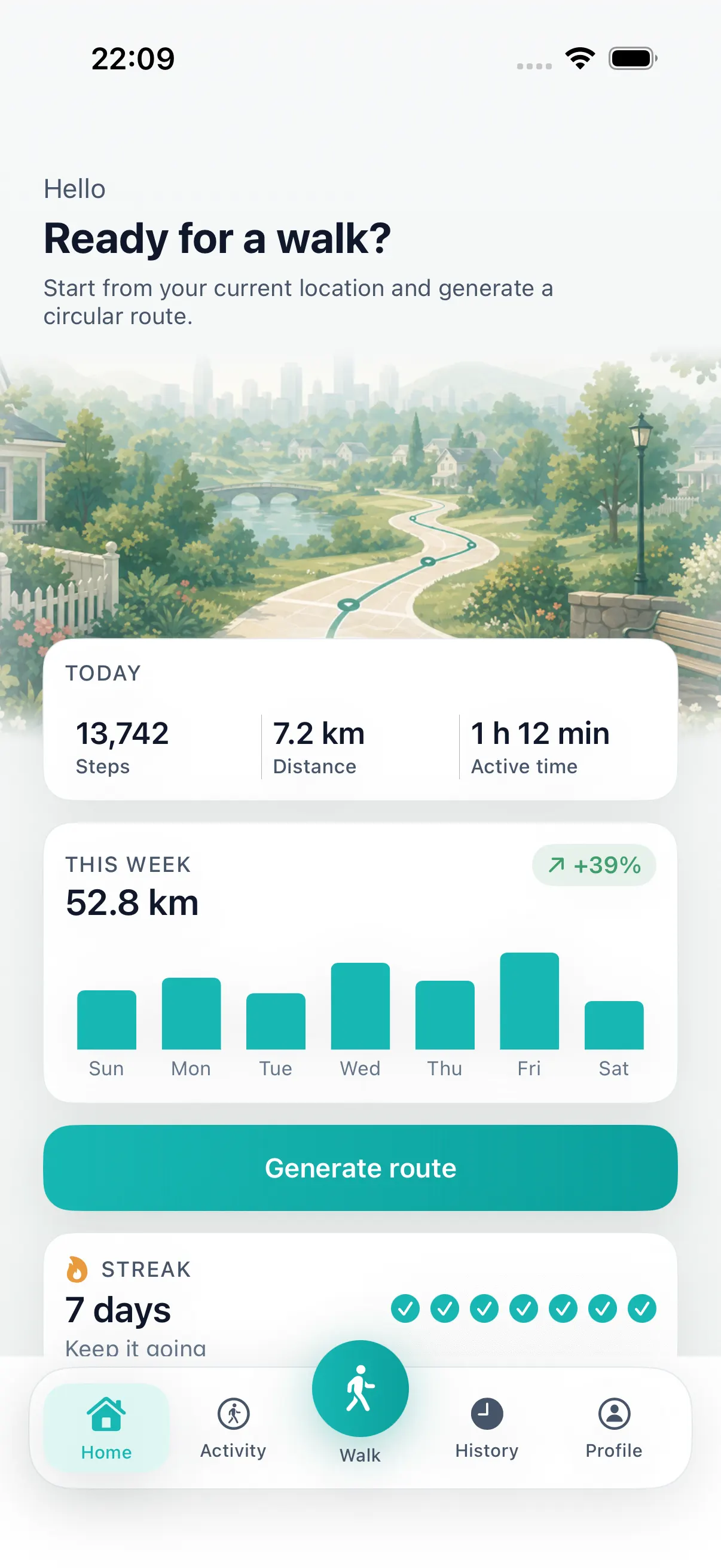
DailyWander keeps the decision small. Choose a distance, generate a loop from your current location, compare route variants, and start the one that fits. Afterward, the walk can appear in your history and, when you allow it, sync with Apple Health.
A simple longer-day walking setup
- Pick a distance that you can repeat, not the longest route you can imagine.
- Use daylight as a cue: a short morning loop, a lunch walk, or an evening route while the days are longer.
- Generate variants so the walk feels fresh without becoming a planning project.
- Track enough afterward to see proof, then make the next walk just as easy to begin.
Use longer days to make walking easier to repeat.
Longer, brighter days can make it easier to start or restart a daily walking routine. Use the extra daylight for a short morning loop, a lunch walk, or an evening route that still finishes comfortably before dark.
Treat summer as a helpful cue rather than a requirement. In darker, hotter, colder, or wetter months, shorten the route, choose a safer surface, and move the walk to the part of the day that best fits local conditions.
DailyWander
Plan the next walk from where you are.
Download the iPhone app, generate a circular route, and choose the variant that fits today's walk.